
Drums · Guides
How We Record a Big American Drum Sound
A big American drum sound comes from three things working together: a large room with high ceilings, a kit that is prepped and tuned for the song, and a multi-mic setup whose phase is checked at the source, before anything is recorded. Here is how we do it in the main room at Hot Milk Studio in Berlin.
Robert Cummings — producer, engineer and drummer
· 6 min read
What we mean by "Big American Sound"
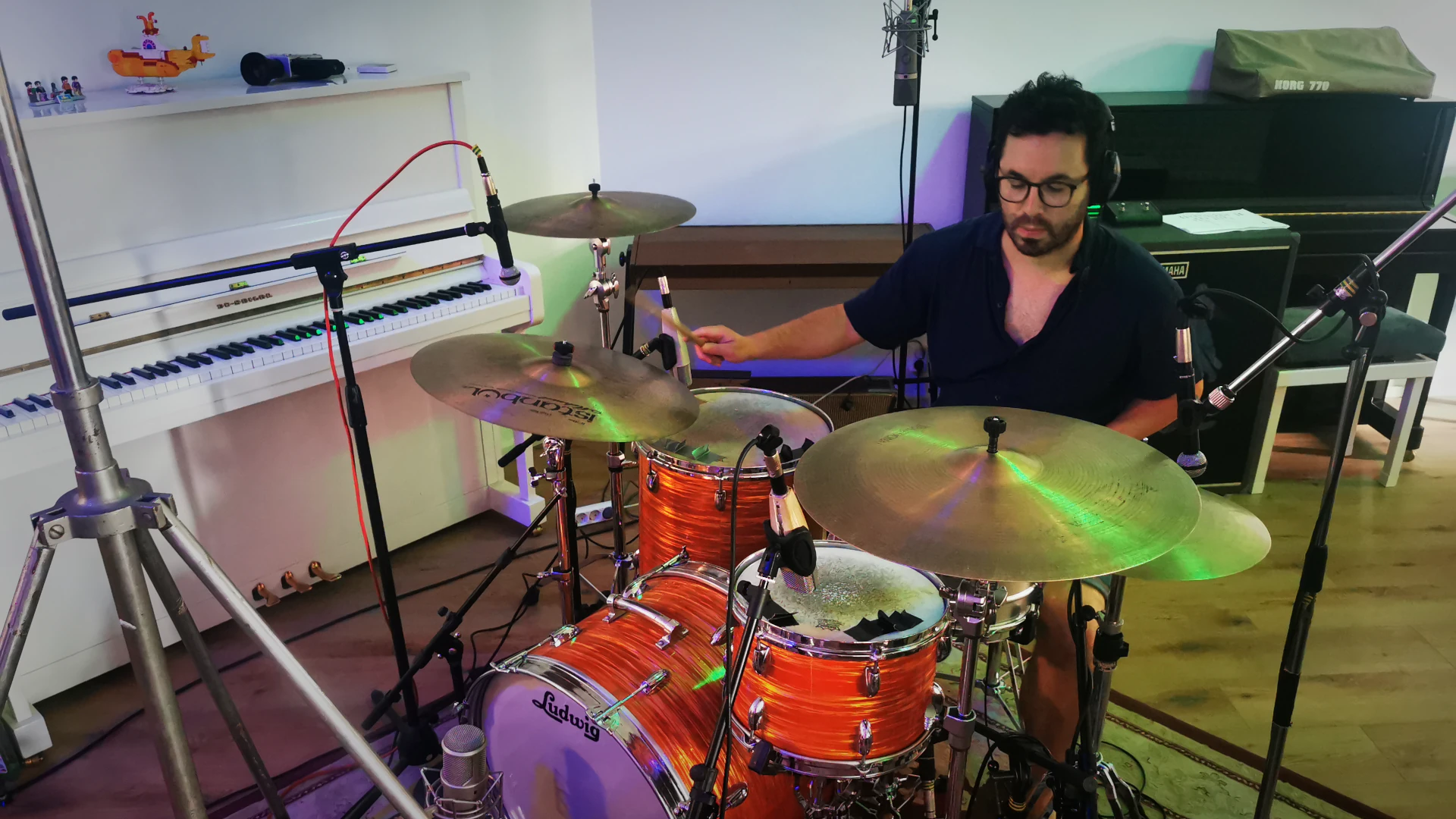
Multi-mic'd drums recorded in our main room: close mics on every drum for granular control, plus overheads and a room pair that capture the size of the space. The result is punchy up close and large and open in the background — a sound small rooms can't produce.
Why the main room works:
- High ceilings (about 4 m) and anti-parallel walls give a big but even ambience without flutter echo.
- Space for very large kits and percussion setups.
- Direct eye contact between engineer and drummer.
- The rest of the band can track at the same time in the other rooms — a little amp bleed can even make the drums sound bigger.
- Daylight, and no noise restrictions: recording is possible around the clock.
For a tighter, more controlled sound we use the drum room instead — see drum recording.
Before the first take: prep and session questions
A big drum sound starts at the kit, not at the mixer.
- Kit, snare and cymbals are chosen per song, with the drummer and the references.
- Fresh batter heads; each drum tuned to resonate freely, then shaped to suit the song.
- As little damping as possible, as much as needed — judged through the mics, not next to the kit.
- Squeaky stools, pedals and rattling stands are fixed before tracking; tuning is re-checked between songs.
On the pre-production call we clarify: Are there pre-production tracks or stems? Is there a click or tempo map — or should we create one? Are there programmed parts or references? Are there tempo changes? Who mixes, and who comps the takes?
Drum Session Prep PDFThe mic setup
Every mic goes to its own mono track — overheads and rooms included — so left and right can be balanced and processed individually later.
| Source | Typical mics at Hot Milk Studio | Position |
|---|---|---|
| Bass drum in | Beyerdynamic M88, Shure Beta 52 or Sennheiser MD421 | Inside, through the port |
| Bass drum out | Lauten Audio Clarion (FET condenser) | In front of the resonant head, centred or slightly off-centre |
| Snare top | Audix i5, Shure SM57 or Sennheiser MD421 | Under the hi-hat, about three fingers above the head |
| Snare bottom | SM57, MD441 or MD421 | Towards the wires, roughly 90° to the top mic |
| Hi-hat | Beyerdynamic M160 or M260 ribbon | Pointing down at the top cymbal, away from the air "puff" and the snare |
| Toms | Sennheiser MD421 (hi-fi option: Neumann TLM 67) | About three fingers above each head |
| Overheads | Spaced pair: Neumann TLM 67 or Beyerdynamic M160 | Snare equidistant to both mics within 1 cm |
| Room | ORTF pair of Beyerdynamic MC930, or a Blumlein pair of figure-8 ribbons | Out in the main room |
| Dirt mic (optional) | — | Centre of the kit above the bass drum, heavily compressed |
Signals run through transformer-coupled preamps (Neve- and API-style Warm Audio, A-Designs Pacifica) and the clean SPL GainStation 8. We rarely compress on the way in; when we do, it's light and transparent.
Why phase matters with multi-mic'd drums
Every mic hears the whole kit, just at different times. Sound travels about 34 cm per millisecond, so the snare reaches its close mic first and the overheads a few milliseconds later. When those delayed copies are summed, some frequencies cancel and others add up — comb filtering. It smears transients and makes drums sound hollow or metallic.
Even tiny offsets matter: snare top and bottom are often only 0.5–1 ms apart, enough to thin out the body of the drum. That's why we check phase at the source:
- Bass drum in/out: flip one mic's polarity, move the mic until the two cancel as much as possible, flip back — now they are as coherent as they can be. Then we confirm in the DAW.
- Snare top/bottom: the bottom mic usually needs its polarity flipped, because the two mics face opposite sides of the drum. We pick the setting with the fuller, louder sum.
- Overheads: we measure from the centre of the snare to each overhead and match the distances to within one centimetre, so the snare stays centred.
- Room mics are deliberately not time-aligned: their delay is the sense of space.
Tracking the drums
- Drums first. For overdub productions we track drums first, so bass, guitars and keys can lock to them. Tracking drums to existing parts with loose timing rarely works well.
- Isolating headphones or in-ears for the drummer, and a click sound that doesn't bleed into the mics. The click can mute automatically at the end so it doesn't leak into the final cymbal decay.
- Whole-song takes where possible, for flow and macro dynamics; punch-ins and alternate fills where useful. Once a keeper is in the can, a relaxed bonus take is often the best one.
- Play for the song. If parts get too busy, we suggest simplifying.
- Clean endings: let the last hits ring out before any stick noise or stool squeak.
- Session samples: after the final takes we record four hits of every drum and crash. These can later reinforce the performance with the kit's own sound.
- Overdubs straight after: tambourine and shaker (ribbon close mic plus the room pair), cymbal swells with mallets, or crashes recorded separately when the drums will be compressed hard.