
The Band: Berlin Manouche with a Signature of Its Own
The Berlin Django Project brings together some of Berlin's most distinctive gypsy jazz musicians. The band combines original compositions by its members with traditional and modern gypsy swing, jazz and chanson — in the tradition of Manouche guitarist Django Reinhardt, but with the raw, open character of the city it calls home.
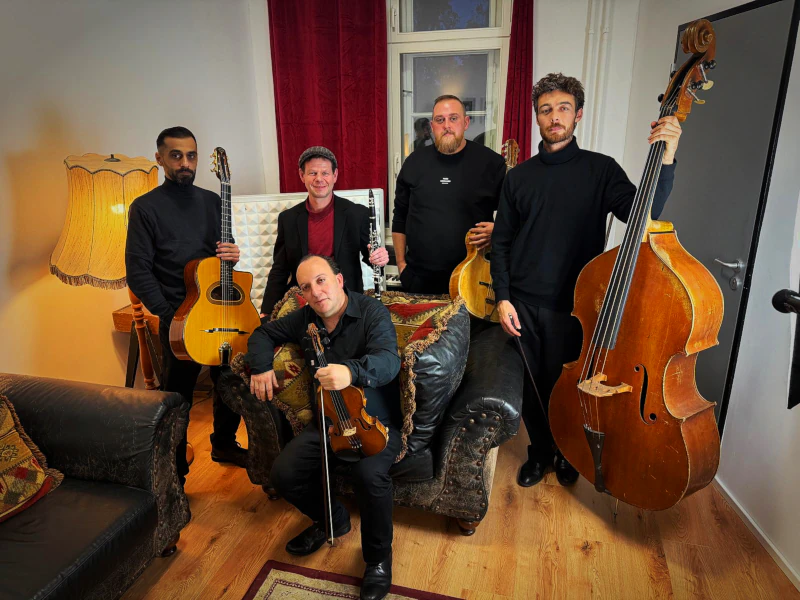
The line-up features Australian jazz violinist Daniel Weltlinger, Mitya Gerasimov on clarinet, guitarists Giovanni Steinbach and Santino Bamberger, and Matthieu Baud on double bass. Musicians from different countries and traditions make the band a small portrait of Berlin.
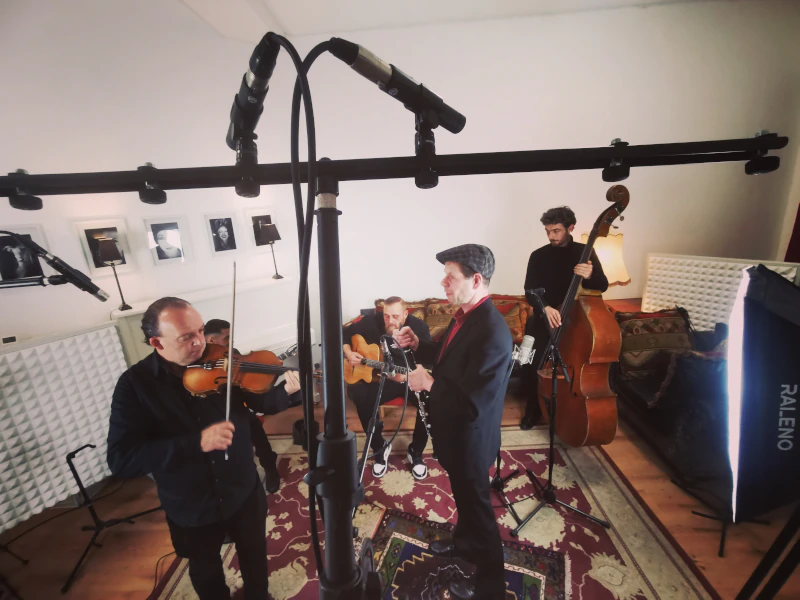
A Living-Room Concert in the Main Room
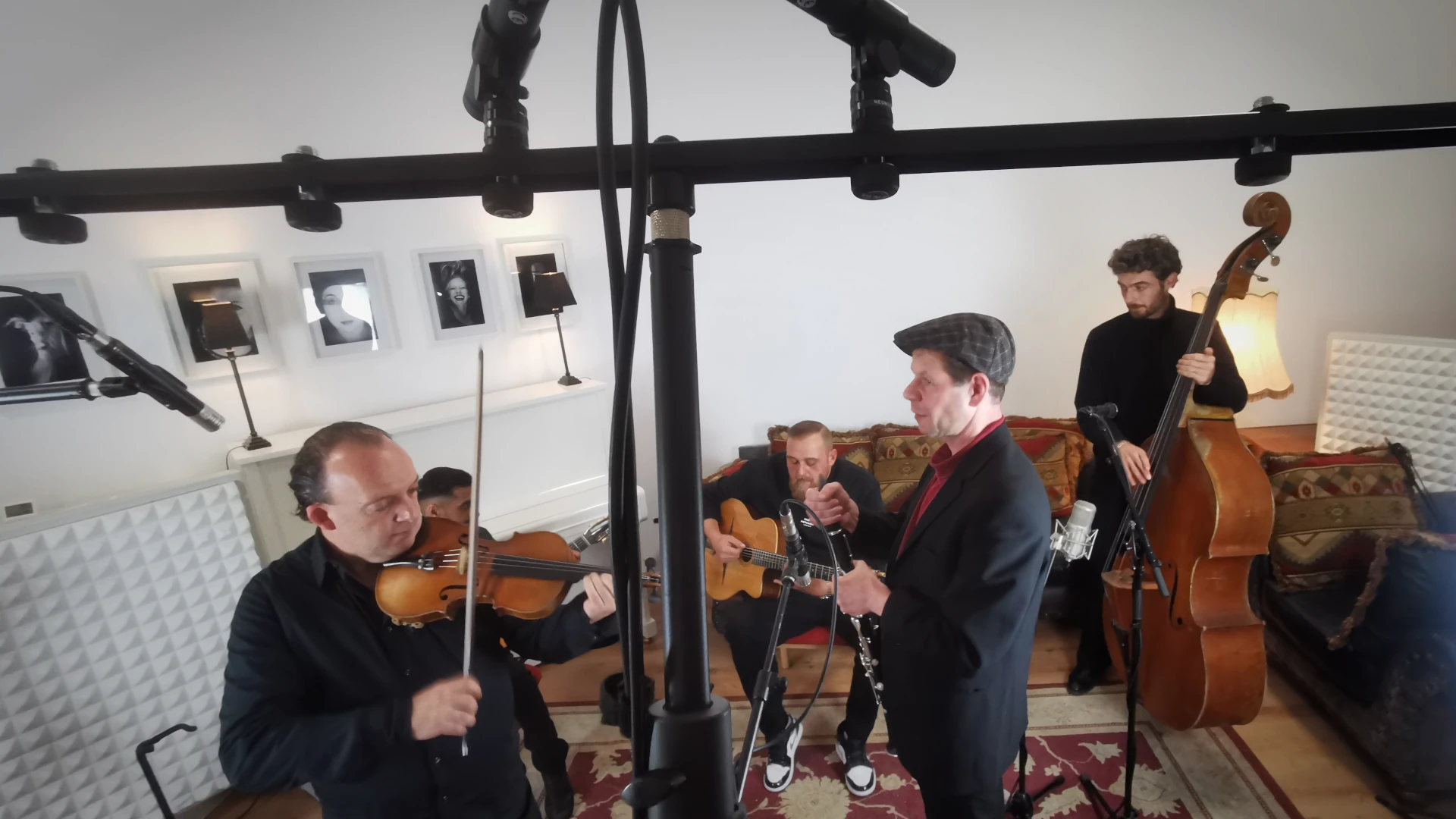
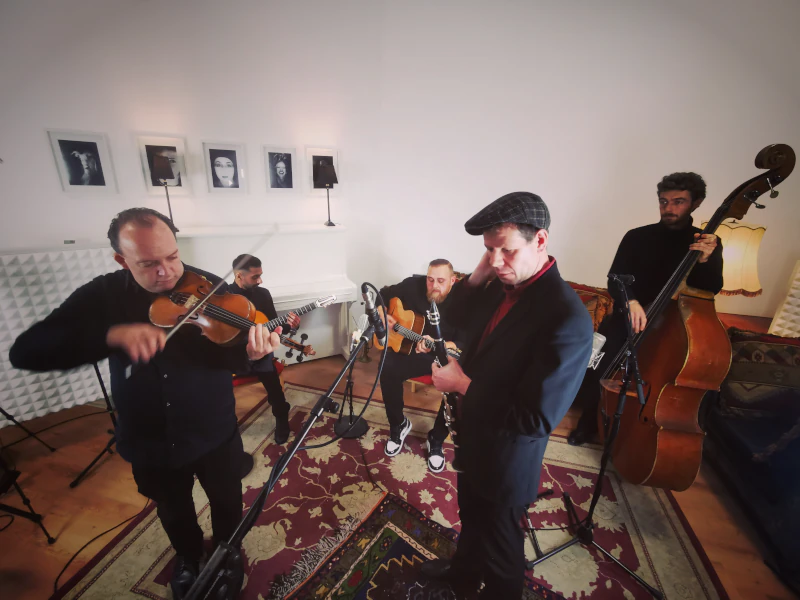
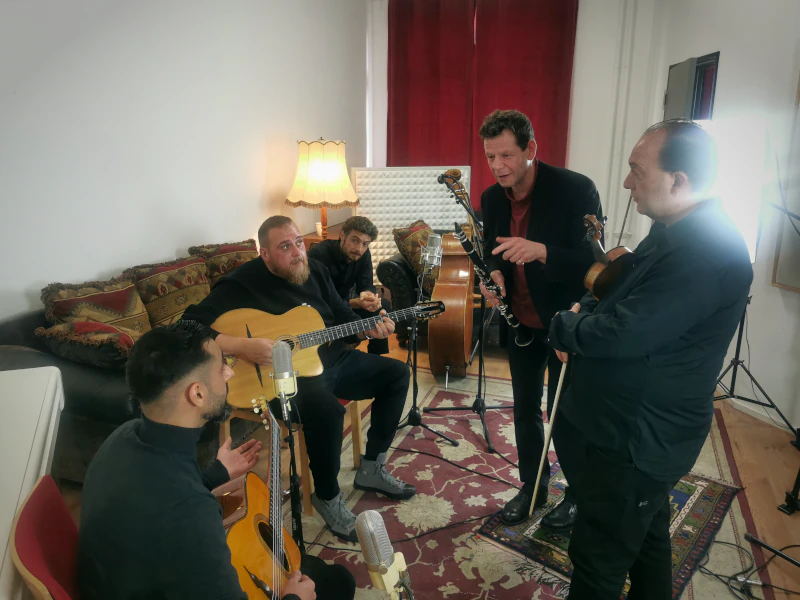
The band set up in the main room exactly as it does on stage. Daniel Weltlinger stood front left with the violin, Mitya Gerasimov beside him with the clarinet. Behind them, cousins Giovanni Steinbach and Santino Bamberger sat facing each other with their guitars, and Matthieu Baud stood at the back right on double bass.
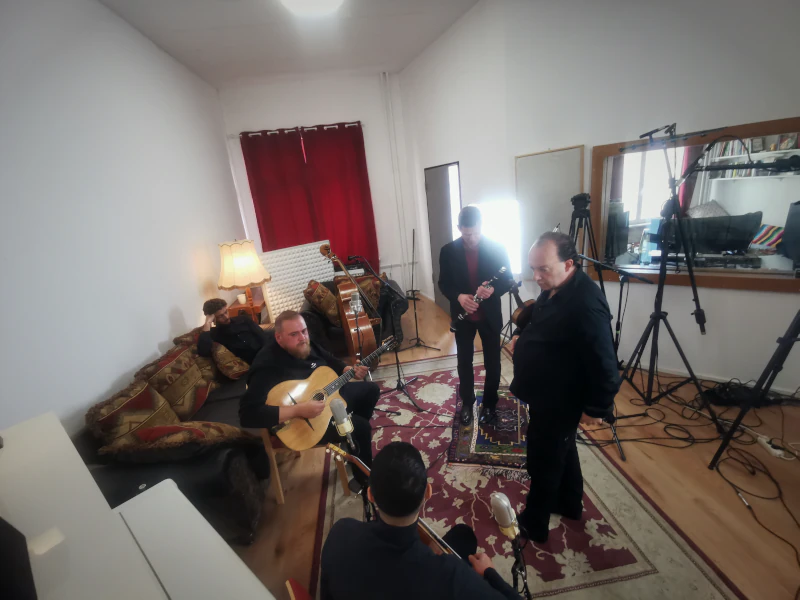
Large sofas and armchairs surrounded the band: the studio was set up as a living room. The band played without headphones and without amplification — the musicians heard each other directly in the room, as at a house concert. The non-parallel walls of the main room prevent flutter echoes and give the ensemble a natural, open room sound.
Why no separation? Gypsy jazz lives on the interplay between rhythm guitars and soloists. That feeling happens between the musicians — and can't be pieced together later from individual tracks.
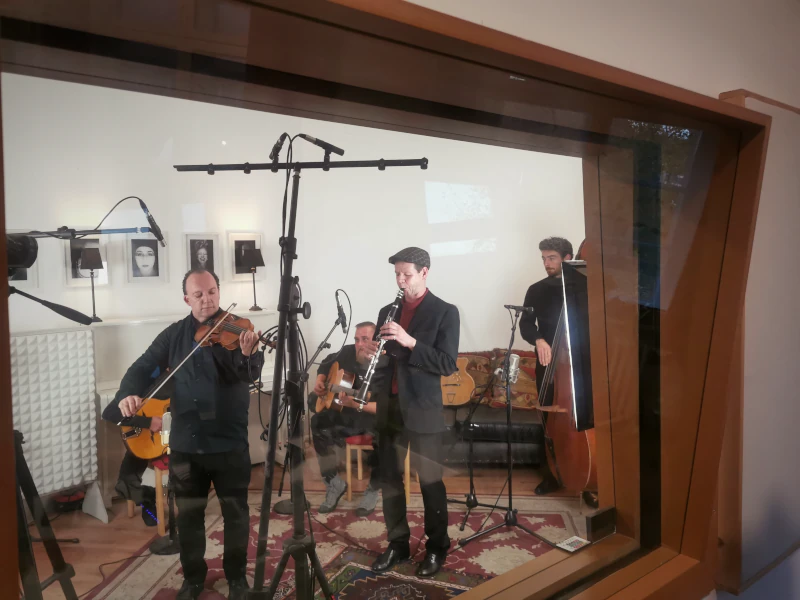
Eight Microphones for Five Musicians
The heart of the recording is a spaced pair (A-B) of two omnidirectional Neumann KM 183s that captures the whole band in the room. Six spot mics give control over balance and presence in the mix.
| Source | Microphone | Polar pattern | Preamp | Why |
|---|---|---|---|---|
| Room | 2× Neumann KM 183 as a spaced pair | Omni | Warm Audio WA273 | Carries the overall sound and most of the room ambience |
| Violin | Gefell M70 capsule on Gefell amplifier | Cardioid | Warm Audio WA273, light EQ | Close and direct, for presence in solos |
| Clarinet | Gefell M70 capsule on Gefell amplifier | Cardioid | Warm Audio WA273, light EQ | Like the violin: the second lead voice |
| Double bass, body | Lauten Audio Clarion (FET) | Cardioid | Warm Audio WA273 | Aimed at the upper body, for tone and volume |
| Double bass, fingerboard | Shure SM57 | Cardioid | Warm Audio WA273 | Delivers the attack and definition of the lines |
| Guitar (Giovanni) | Golden Age Project R1 MK2 (ribbon) | Figure-8 | Warm Audio WA412 | The figure-8's side rejection keeps violin and clarinet out |
| Guitar (Santino) | Golden Age Project R1 MK2 (ribbon) | Figure-8 | Warm Audio WA412 | As above; the WA412s make the guitars snappy |
In this music, the Manouche guitars carry both the harmony and the rhythmic drive. That's why they ran through the Warm Audio WA412: the preamps give them the punch their role as the rhythm section needs. The ribbon mics were aimed so that their nulls point at the lead instruments — keeping the guitar tracks clean despite the shared room.
Two Days, 20 Pieces, 13 Takes
No piece was played more than three times. We didn't want to get stuck on any one song and lose the mood, so after three takes at most we moved on to the next piece. Over two days, that produced recordings of around 20 pieces.
From this material we selected the 13 strongest takes. Editing was kept targeted: a few intros and endings, plus one or two complete heads that we swapped between takes. Because the band played without a click, every edit sits at a musical transition — where the band starts afresh anyway.
Mixing and Mastering In-House: Room Instead of Reverb
In the mix, most of the ambience comes from the spaced pair — the real sound of the main room. Artificial reverb was added only sparingly, as a finishing touch. The result sounds lively and authentic, close to what the band played in the room.
In the mix, the two guitars ran through Summit Audio TLA-50 tube compressors for harmonic richness and control. As with almost all our productions, the mix was done in Cubase. The mix bus ran through a Tegeler Audio EQP-1 and a Tegeler Audio VTC.
Mastering was done in-house too. As the final limiter we used the Ozone Maximizer in IRC IV Modern mode, one of our favourites at Hot Milk Studio. We aimed for between −14 and −12 LUFS: deliberately on the loud side for jazz, without sacrificing the band's drive.
The mixes were completed almost a year after the recordings, because Daniel Weltlinger was on tour with various acts in the meantime.
Vinyl EPs in the Works
The recordings will be released as a series of EPs; two EPs of four pieces each are currently planned, with vinyl editions in the works. The first EP contains Dream Of You, In dieser Stadt, Kalo Tango and Swing for Voti.
For the vinyl cut we prepare a dedicated premaster:
- No maximizer and no limiter on the mix bus.
- We control sibilance with the HiFal2 plugin by Schwab Digital.
- Bass frequencies below 120 Hz are largely mono.
That way the cutting engineer can produce a loud full-range cut without the stylus hitting its limits.
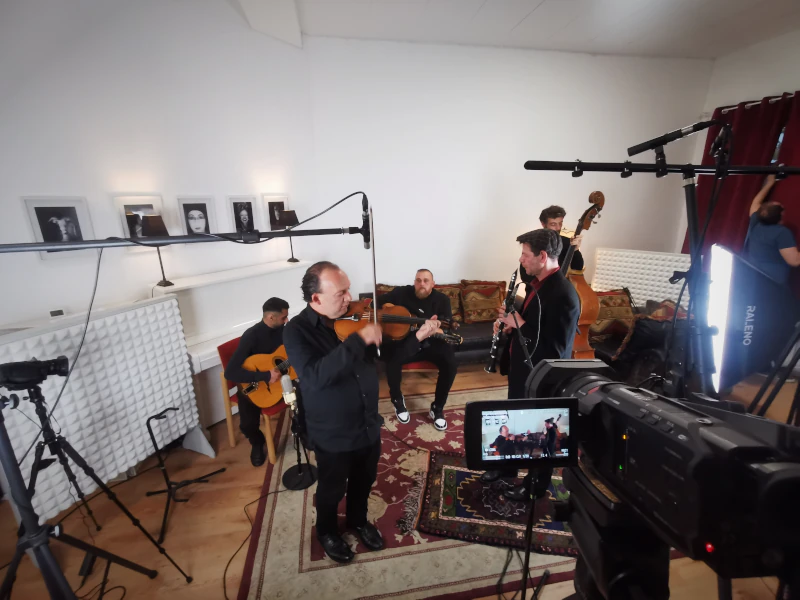
The Session on Video
Johannes Schäfer filmed the live sessions with two cameras and edited the videos. The audio in the videos comes from Robert Cummings’ first mix for the band from January 2026.
Session video clips

In dieser Stadt — Berlin Django Project

Kalo Tango — Berlin Django Project

Swing for Voti — Berlin Django Project
In the Band's Words
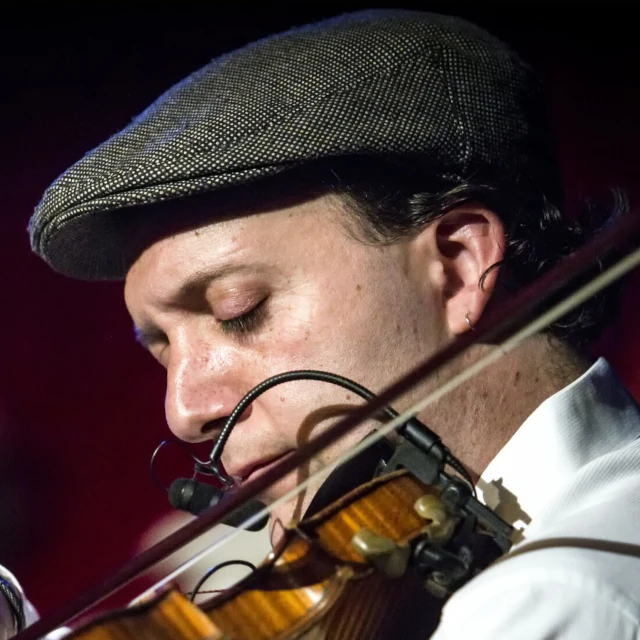
“Fantastic studio in Berlin with a warm atmosphere and top gear. Rob is really great to work with and a truly great studio engineer. Highly recommended!”Track Listing
First EP: Dream Of You · In dieser Stadt (Charly Njiessen) · Kalo Tango (Daniel Weltlinger) · Swing for Voti (Gallo Weiss)
All 13 recordings: Body and Soul · Dream Of You · Exactly Like You · Gloomy Road · I Know About You · In dieser Stadt · Isaiah Swing · Kalo Tango · Lolita · Paquito · Song for Hänschen · Swing for Voti · Troublant Boléro
The Result
13 tracks that sound like a concert in the living room: five musicians hearing each other directly, captured with eight microphones and a room that plays along. Recording, editing, mixing and mastering all came from one team — and the material is prepared for vinyl.